

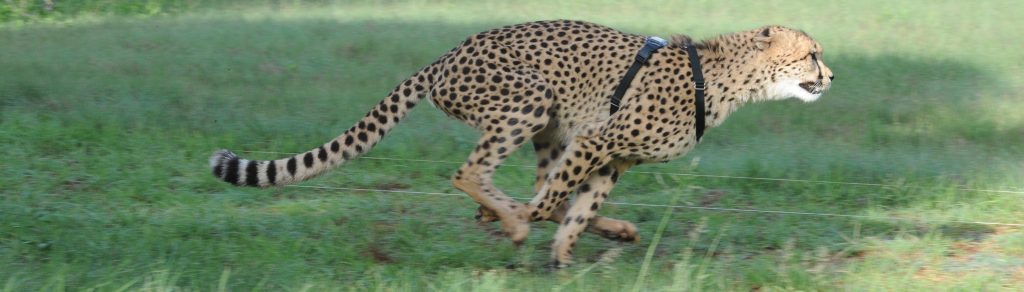
Photo credit: Alan M. Wilson
Draft programme
Session 1: Linking mechanics to energetics in the context of large- and small-scale animal movement and the environment
Flight
Anders Hedenström (Lund University, Sweden)
Avian flight aerodynamics and energetics linked to migration: limits to performance
Lucy Hawkes (University of Exeter, UK)
Flight physiology and adaptations for high altitude flight: bar-headed geese Himalayan migration
Douglas Altshuler (The University of British Columbia, Canada)
Ecological, energetic and evolutionary trade-offs in the design for hummingbird flight maneuvering
Emily Shepard (Swansea University, UK)
Flight energetics and avian movement patterns in relation to environmental factors
Terrestrial locomotion
Alan Wilson (The Royal Veterinary College, UK)
Field biomechanics, linking muscle energetics to performance and survival
Herman Pontzer (Duke University, USA)
Evolutionary and ecological context of locomotor energetics
Robyn Hetem (University of The Witwatersrand, South Africa)
Surviving in a hot environment: locomotor physiology and ecology
Vincent Careau (University of Ottawa, Canada)
Multivariate mixed models for studying individual variation in locomotor behaviours
Session 2: Linking swimming energetics and mechanics to ecology and robotics
Valentina Di Santo (Stockholm University, Sweden)
Swimming energetics in relation to speed, body form and anaerobic vs aerobic energy supply
Terrie Williams (University of California, Santa Cruz, USA)
Linking energetics to the diving physiology and ecology of marine mammals: challenges to the oxygen pathway
John Dabiri (California Institute of Technology, USA)
Linking energetics and robotics to the hydrodynamics of jet propulsion in marine coelenterates
Session 3: Linking finer-scale patterns of energetics and mechanics to locomotor ecology
Mimi Koehl (University of California, Berkeley, USA)
Swimming in a turbulent environment
James Liao (University of Florida, USA)
Fish swimming energetics and hydrodynamics in relation to complex flow
Timothy Higham (University of California, Riverside, USA)
Biomechanics and ecology of lizard movement
Session 4: Linking muscle energetics to mechanics: informing design of bioinspired assistive devices and robots
Gregory Sawicki (Georgia Tech, USA)
Energy saving mechanisms in locomotion: implications for ecology and gait assistance
Natalie Holt (University of California, Riverside, USA)
Energetics of muscle contraction, links to mechanics and animal function
Glen Lichtwark (The University of Queensland, Australia)
Cost of transport: integrating muscle energetics into musculoskeletal models
John Bertram (University of Calgary, Canada) Using constraint optimization approaches to running economy
Alexander Badri-Sprowitz (Max Planck Institute for Intelligent Sytsems, Germany)
Linking mechanics to energetics in the context of biorobotic design
You must be logged in to post a comment.