

Transgenerational Epigenetic Inheritance
Date: 4th – 7th October 2015
Location: Wiston House, Steyning, West Sussex, UK
Organisers: Edith Heard and Ruth Lehmann
The transmission of epigenetic states across cell divisions in somatic tissues is now well accepted and the mechanisms are starting to be unveiled. The extent to which epigenetic inheritance can occur across generations is less clear, but represents a very exciting area with major implications for human health, plant and animal breeding and evolution. Given the press coverage and public interest at the time, as well as the intensive research and certain controversy surrounding the topic, this workshop provided an opportunity for timely exchange between experts from different disciplines. Some of the outstanding questions include: What triggers heritable epigenetic changes and how stably are they propagated? To what extent can one exclude a DNA sequence based mechanism? What are the types of covariates that must be taken into account in epidemiological studies? What types of strategies will be required to define the nature, extent and mechanisms of non-Mendelian transgenerational inheritance?
The Workshop brought together experts in various fields that bridge the gaps between epidemiology, nutrition, genetics, development, neurobiology and the germ line, as well as specialists in epigenetic mechanisms, mitochondrial inheritance and evolutionary biology. It incorporated theoretical, philosophical and experimental approaches. Lines of evidence for and against epigenetic inheritance were discussed, as well as mechanistic considerations, in different organisms.
Organisers & Speakers
Edith Heard Institut Curie, France
Ruth Lehmann Skirball Institute, USA
Alexei Aravin California Institute of Technology, USA
David Baulcombe University of Cambridge, UK
Vincent Colot IBENS, France
Anne Ferguson-Smith University of Cambridge, UK
John Harris University of Manchester, UK
Eva Jablonka Cohn Institute, Israel
Rob Martienssen Cold Spring Harbor Laboratory, USA
Eric Miska University of Cambridge, UK
Pat O’Farrell University of California, San Francisco, USA
Marcus Pembrey University of Bristol, UK
Andrew Pospisilk MPI of Immunology & Epigenetics, Germany
Oliver Rando University of Massachusetts, USA
Oded Rechavi Tel Aviv University, Israel
Azim Surani University of Cambridge, UK
Susan Strome University of California, Santa Cruz, USA
Mick Tuite University of Kent, UK
Erica Watson University of Cambridge, UK
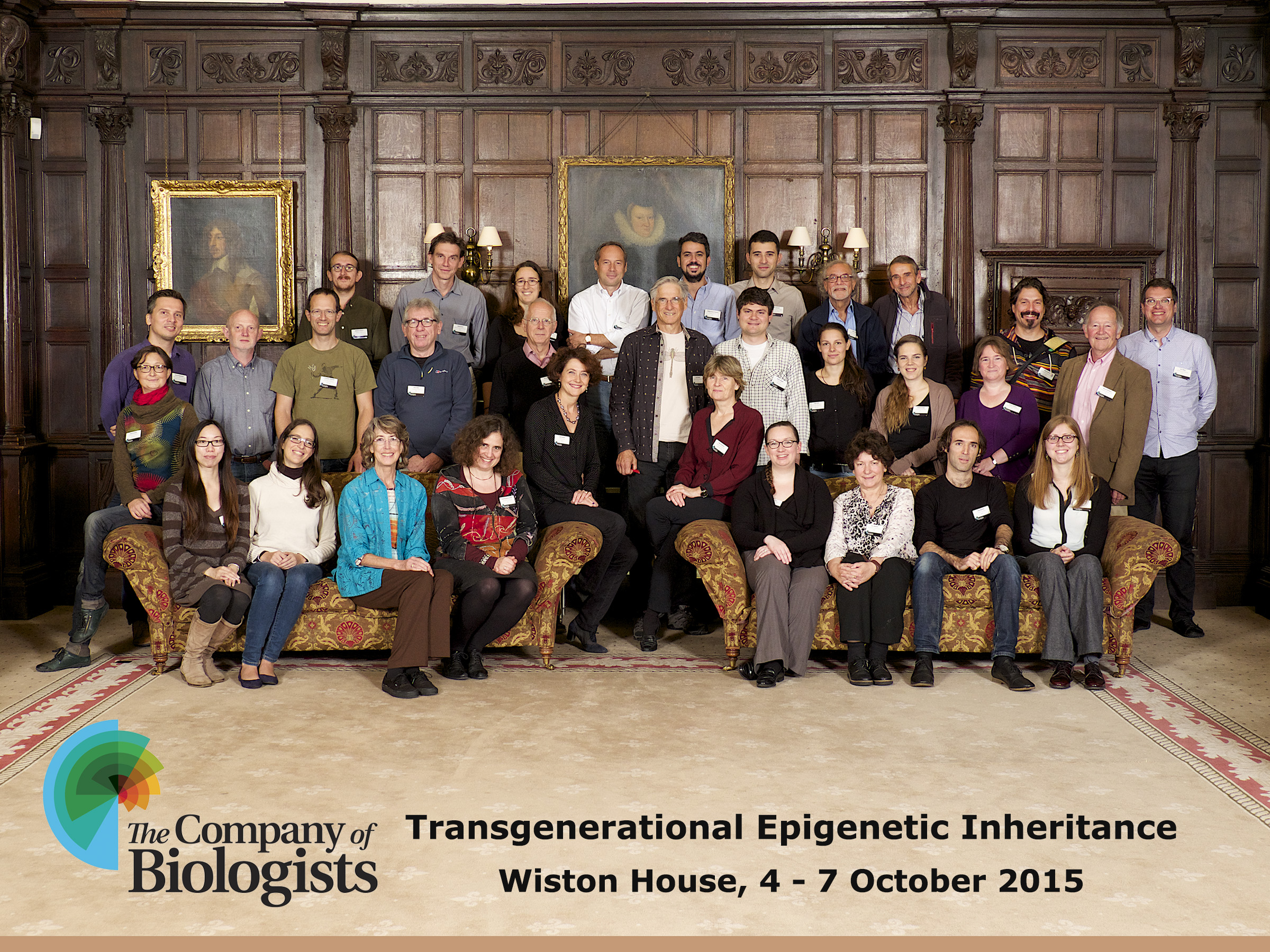
Workshop Photo
Slideshow
Transgenerational Epigenetic Inheritance
4th – 7th October 2015
Wiston House, Steyning, West Sussex, UK
You must be logged in to post a comment.