


23 October 2026
The theme of this year’s International Open Access Week is ‘The Cost of Knowledge’, which encourages discussion around two key questions: why are the costs of publishing increasing and who should bear those costs? At The Company of Biologists, these questions are particularly relevant as we explore new ways to support authors, reviewers and readers, while maintaining a sustainable publishing model. We have been reflecting not only on what publishing costs, but also about what creates value and how that value should be funded.
The growing burden on the publishing ecosystem
Over the past century, publishing output has been doubling every 12-15 years and, in recent years, submission volumes have outstripped even this rapid growth. This places a significant burden on the publishing ecosystem in every way, with editors and reviewers under growing pressure to handle the ever-increasing volume of manuscripts. Discussions in the academic community often home in on monetary costs such as publication charges and publisher profits but it is important to remember that the cost of knowledge is not solely a financial one. Time and effort are invested by academics, often acting in unpaid capacities, as editors and reviewers in addition to their roles as authors. While The Company of Biologists has long recognised the crucial role our Editors play through financial compensation, we have more recently been exploring if and how we can extend this recognition to peer reviewers.
Recognising the value of peer review
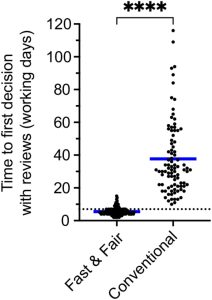
A key bottleneck in the publishing process is securing peer reviewers, which can incur significant time on the part of editors and, more broadly, slow research dissemination and access to new knowledge. At The Company of Biologists, our journal Biology Open started the Fast & Fair peer review initiative (Gorelick and Clark, 2025) to investigate whether incentivising peer reviewers could accelerate the peer review process without affecting the quality of review reports. Under this experiment – still ongoing – we pay £220 to reviewers (selected from a pool of pre-recruited, highly-qualified researchers) for submission of a quality review, assessed against a structured rubric, within four working days. This enables Biology Open to provide a promise to authors that they will receive a first decision following peer review within seven working days. After a year and a half, the findings are encouraging (Gorelick and Clark 2026, preprint): editors find it much easier to recruit reviewers, review quality has remained high and our authors are receiving decisions much faster than they traditionally would have – post-review decisions are typically received within seven working days, and the time from submission to acceptance now sits at just over six weeks. Feedback from authors and reviewers has been positive; moving forward we will be continuing to monitor how Fast & Fair peer review is impacting submission volume, journal output and author and reviewer return.
“I was incredibly impressed with how fast and smooth the Biology Open review and publishing process was. The submission system was easy to navigate, and the editorial and production teams were responsive and helpful when needed. Most notably, the speed at which my article was reviewed and published was exceptional. My PI remarked that he had never experienced such a quick turnaround in all his years of publishing,” a Biology Open author said.
This isn’t an entirely novel approach for The Company of Biologists. In fact, at the beginning of this century, we were still posting cheques for £20 to reviewers upon successful receipt of their review within a given timeframe. What Biology Open has done is to take an old policy at the Company and revamp it for the 21st Century. By paying reviewers, we recognise the important contribution that peer review makes within the publishing ecosystem, and we have dramatically improved the service we offer to authors.
Who pays for value?
Our Fast & Fair peer review initiative highlights an important reality of modern publishing: creating additional value almost always comes with additional cost. By compensating reviewers, we have accelerated decision-making, improved the author experience and recognised the vital role that peer reviewers play. However, the implementation of this initiative has come at a financial cost, and one that – as a small not-for-profit publisher – we cannot easily absorb.
Importantly, these costs are incurred regardless of whether a manuscript is ultimately accepted or rejected. For large commercial publishers, additional costs may be absorbed across extensive portfolios, where manuscript transfer arrangements can help offset the costs associated with rejected submissions. Smaller independent and not-for-profit publishers typically have fewer opportunities to realise these advantages.
This is a challenge that extends well beyond peer review. Publishers are facing increasing numbers of papers with integrity concerns and significant financial investment has been made, both in technology and human resource, to tackle this – with the aim of identifying integrity concerns as early as possible to maintain the quality and rigour of the papers we publish. As submission volumes continue to increase and publication misconduct becomes more sophisticated, these costs are rising across the industry.
Open access publishing makes this challenge particularly visible because costs are often concentrated in article processing charges (APCs). Yet APCs are only one mechanism for recovering publishing costs. Subscription models, transformative agreements and read-and-publish deals all ultimately rely on funding from institutions, funders or researchers themselves. The route by which costs are recovered may differ, but the underlying costs remain.
This raises an important question for the research community: who should pay for quality? Universities, funders, libraries and publishers all contribute to the scholarly communication ecosystem, but increasing expectations around speed, service and research integrity are driving additional costs across the system. Discussions about the cost of publishing often focus on publisher profits, yet for many society and not-for-profit publishers the central challenge is not generating profit but finding sustainable ways to fund the services that researchers increasingly expect.
Looking forward
Open Access Week prompts us all to consider not only the financial costs of publishing but how publishers can innovate to create value. Researchers consistently value research integrity, rigorous peer review, editorial expertise and high-quality author service, which all require investment. Equally, authors place value on reputation, visibility and citation metrics, which are supported by activities that also require investment. The challenge is not that the community disagrees on what it wants, but that expectations continue to increase, while pressure to reduce costs remains.
As a not-for-profit publisher, The Company of Biologists exists to serve the scientific community. We have invested in high-quality peer review, high levels of editorial expertise and robust integrity checks because we believe these are central to serving the community and maintaining trust in our scientific outputs. Through initiatives such as Fast & Fair peer review, we continue to explore how publishing can evolve to best support the research community. Our aim is simple: to ensure that any increase in cost results in a clear benefit to our authors, reviewers and readers and contribute to a publishing ecosystem that is sustainable, trusted and effective.
You must be logged in to post a comment.