

20 October 2026
In animals, body proteins are constantly synthesized and degraded in a dynamic process called protein turnover. This process is highly energetically expensive and is estimated to constitute 50% of energy usage in living organisms. Climate change has resulted in rising temperatures and an increase in carbon dioxide concentrations in our oceans which in turn has caused a reduction in the growth rates of aquatic animals. Whilst a postdoc at the University of Exeter, Trystan Sanders set out to investigate whether the slower growth rates observed in aquatic ectothermic animals under rising carbon dioxide levels are due to changes in body protein turnover.
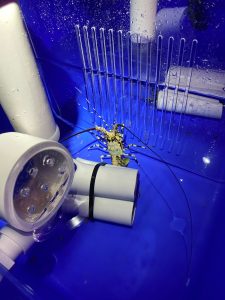
Trystan used a Travelling Fellowship from Journal of Experimental Biology to visit Prof Chris Carter’s lab at the Institute for Marine and Antarctic Studies (IMAS) at the University of Tasmania in Australia, where he investigated protein turnover in tropical rock lobsters.
The Travelling Fellowship from Journal of Experimental Biology enabled Trystan to learn a technique developed by Chris Carter that involves using stable isotopes to measure protein synthesis in fish. With guidance from Chris Carter and his lab, Trystan was able to apply this technique to study protein turnover in a crustacean. To measure protein synthesis, lobsters were fed meals enriched with the stable isotope 15N and the excretion of this label into the surrounding water was then followed over a 48-hour period by taking samples for analysis by mass spectrometry. In conjunction, nitrogenous waste excretion was also measured post feeding to study the efficiency with which the lobsters converted energy from their meal into body protein. These data were coupled and a stochastic endpoint model applied which enabled Trystan to acquire an estimate for rates of protein synthesis in the lobsters after a meal.
“This experiment would not have been possible without my visit to IMAS. However most importantly of all and something that is not easily quantifiable on a CV or grant application, I met a great bunch of people during my visit to IMAS who I had an absolute blast working with,” Trystan said.
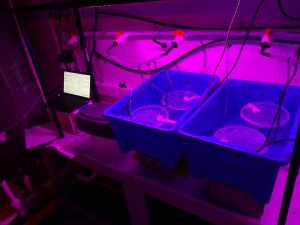
Trystan noted that there were challenges with the project but by working with Chris Carter’s team, he was able to collect all of his intended measurements and samples by the end of the visit. Once he had returned to Exeter, Trystan continued to collaborate with fellow scientists in Chris Carter’s lab to analyse his data. This resulted in the interesting finding that, out of all the proteins the lobsters had synthesised (built) after a meal, the majority of this protein was broken down with only 30% being retained as body mass.
Since conducting his Travelling Fellowship, Trystan has authored a research article which has now been published in Journal of Experimental Biology (JEB). When reflecting on why he chose JEB, Trystan said: “UTAS were excellent hosts and we got really high quality data in the end which we wanted to publish in a well-respected animal physiology journal. JEB seemed like the obvious choice – not just because of the journals high standing in the field, but because The Company of Biologists were instrumental in making the work possible through funding my visit to UTAS. I’ve also always had the utmost respect for JEB, from their publishing ethos to how they treat/recognise their reviewers. It’s of course also nice to have a tree planted on your behalf!”
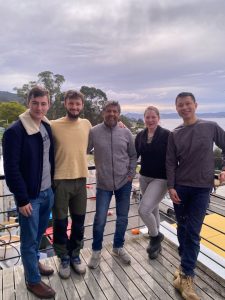
Trystan praised the impact the Travelling Fellowship had on his research and future career: “Reflecting a year on from my Travelling Fellowship I didn’t expect my visit to UTAS would have such a strong influence on my current research directions and interests. I have even since (finally) run my dream experiment on high carbon dioxide and protein turnover in prawns with the support of UTAS, using the very same isotope labelling technique I learnt in my Travelling Fellowship!” The Travelling Fellowship has also solidified an international collaboration, with Chris Carter visiting Trystan in the lab at Exeter. Trystan is now a postdoc at the Marine Biological Association in Plymouth where he continues his research using the same isotope labelling technique he learnt on his Travelling Fellowship to investigate the effects of microplastics on zooplankton.
You must be logged in to post a comment.