

2 November 2026

This year’s Publication Integrity Week takes place on 2-5 November. The event is organised by the Committee on Publication Ethics (COPE) for those involved in scholarly publishing, with themes including the evolution of scholarship, conflicting incentives, collaboration and practical ethics.
This Publication Integrity Week, we spoke to John Nichols, Publication Integrity Lead at The Company of Biologists, about publication integrity challenges and how the Company is tackling them.
In a nutshell, what does publication integrity mean?
It encompasses a whole range of aspects around a paper and its route to publication – not only the content of the manuscript but also authorship, ethical standards and the peer review process. At its core, publication integrity is about ensuring that a publication is a trustworthy and reliable addition to the literature.
What are the integrity challenges faced by publishers?
There are the traditional challenges such as data manipulation or misrepresentation, but the issues are constantly evolving. Recently, across the whole industry, we have experienced an increase in submissions originating from paper mills. These are organisations or groups of individuals who generate poor-quality or fraudulent manuscripts, often with fabricated or stolen data, and sell the authorship slots to researchers. Publishers also face challenges related to manipulation of the peer review process and unethical authorship processes such as the selling of author spots on papers. The development and increased availability of generative AI is bringing in new challenges as well. At The Company of Biologists, we are continuing to innovate to ensure that our policies and processes are up to date to meet these challenges, and we have an in-house Publication Integrity Team with the expertise to follow up publication integrity issues.
What tools and technologies does The Company of Biologists use to screen for integrity issues in manuscripts?
We have introduced tools for screening manuscripts when they are first submitted to our journals, the outputs of which our Managing Editors review. There is a real focus at this stage on identifying submissions from paper mills. By screening for paper mill-derived manuscripts early we can filter out these problematic submissions and avoid unnecessary demands on our Handling Editors and peer reviewers. We have a couple of tools, and significant in-house expertise, to identify potential papermills. One of the tools we use for this is the STM Integrity Hub, which checks for signs of fraudulent submission activity across publishers, as well as various other integrity issues in the submission. As a smaller publisher, having that cross-publisher cooperation is really helpful to us. At this stage, we also use an AI-driven paper mill detector that matches submissions to known paper mill templates and checks the reference list and author histories to identify signs that the manuscript is related to a network of questionable works.
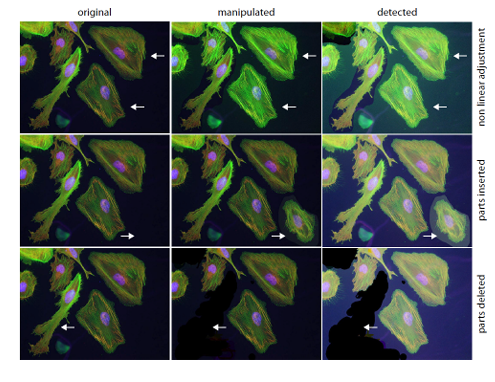
Later in the process, after peer review, we place increased focus on manuscript content and data integrity through our routine integrity checks. Every manuscript is checked with the Crossref Similarity Check tool to screen for plagiarism, and all of the figures and supplementary figures in papers accepted for publication are screened with a tool called Proofig AI, which checks for image duplication and potential image manipulation.
How is the use of tools balanced with human input?
The tools are used in parallel with human screening to identify integrity concerns. For decision making and the follow-up of any issues that are flagged by the tools, human expertise is always involved. Reports from the integrity tools used at the submission stage are always reviewed by an Editor and in some cases, when issues are identified, they are referred to our Publication Integrity Team for further investigation. When checking articles accepted for publication, figures are also screened manually by our Production team for signs of manipulation, and all issues arising from these checks are looked at in detail by the Publication Integrity Team.
How has AI influenced publication integrity practices?
The development of AI has both helped and hindered publication integrity. A lot of the tools we use have an AI or machine learning element, and those tools have boosted our power to detect problems. On the other hand, it’s becoming much easier to use AI to circumvent our detection of integrity issues. Taking paper mills as an example, there’s less of a need for images to be reused across manuscripts – a clear signal of integrity issues – because new images and ‘data’ can be generated with the click of a button.
What advice would you give authors to help avoid integrity concerns during submission?
The recommendation would be to read our journal guidelines for manuscript preparation and our journal policies before submission. In particular, the guidance on image and data presentation, authorship, and use of AI. Adherence to these guidelines may help avoid delays later in the process. We would also encourage increased data availability; for example, the use of supplementary blot transparency figures or the deposition of data sets in well-established repositories. More broadly, many publication integrity tools now incorporate reference list analysis, so good citation practices, including carefully assessing the reliability of the papers you cite, are as important as ever.
If I’m an author and I’m contacted by the Publication Integrity Team before publication, what does that mean and what should I expect?
First of all, we never assume misconduct or wrongdoing. If you are contacted it means something has been flagged in our screening that requires a closer look. We commonly deal with situations where images have artifacts introduced during figure preparation, or where the data have been presented in a way that needs clarifying. These aren’t inherently integrity issues but require some follow up. We will contact you and inform you about the issue that has been found. In line with journal policy, we will ask for the supporting data, and all our journals expect that the original data underlying a study will be readily available. In the majority of cases, the issues are resolved with minor changes to the figure or manuscript text, supported by the original data.
How does COPE fit in with integrity practices at The Company of Biologists?
Our journals are members of COPE, who provide useful guidance that informs the standards we adhere to when conducting our investigations both before and after publication. Publication Integrity Week is particularly helpful because it brings together people working across publication integrity and research integrity to share their thoughts, ideas and experiences, and that is really valuable to us.
Publication Integrity is a shared responsibility across authors, editors, reviewers and readers that enables us to maintain trust in scientific outputs and benefits the wider scientific community. This Publication Integrity Week, we look forward to engaging in discussions across the scholarly community and reflecting on how we can evolve our integrity policies and processes as a Company.
You must be logged in to post a comment.