


Message in a bottle
Stories on how The Company of Biologists supports the biological community

As part of our 100th birthday celebrations, we asked you to share your stories and you did not let us down. The responses were amazing and we have selected a handful to share with you here.
Chloé Lahondère
Associate Professor
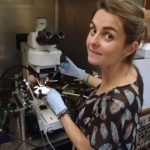
I received a JEB Travelling Fellowship in 2012, which allowed me to visit Jeff Riffell’s lab (Seattle, WA, USA) for three months, right after obtaining my PhD in France. During my stay, I was able to perform several experiments, which I completed after joining Jeff’s lab as a postdoc. The paper emerging from this work was published in Integrative and Comparative Biology.
Getting that fellowship made a huge difference in my career, as I then joined Jeff’s lab as a postdoc a couple of months after. From a personal point of view, it allowed me to follow my partner, who was also going to start a postdoc in Seattle, so the impact of this fellowship was both on the personal and professional side.
I started my own lab in 2017, and I have since hosted a recipient of this same fellowship, which was amazing! Thanks again for your support, for providing ECRs a chance to visit labs all over the world and for increasing networking opportunities!
Image: Chloé in Jeff’s lab conducting electrophysiological assays (credit: Clement Vinauger)

Chris MacDonald
Senior Lecturer
The Company of Biologists has been central to my entire research career to date.
Journal of Cell Science published my first paper as a PhD student and my first paper as a PI. The Company supported the first meeting I organised, with a significant contribution to host keynote speakers at the 39th SMYTE conference in York 2024. I was also interviewed about Open Access and our paper being the first from the University of York to use the Read & Publish agreement.
The Company of Biologists has helped raise the profile of multiple members of my lab by publishing First Person interviews of Kamilla Laidlaw, Katherine Paine and Martha Cruz, which has helped with the dissemination of their research and career moves.
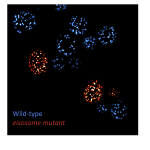
Journal of Cell Science has helped me disseminate two stories on the yeast compartments called eisosomes.
I genuinely value The Company of Biologists as an outlet for our research and will be guiding future researchers to you after three brilliant experiences as a PI to date.
Mariana De Niz
Research Assistant Professor
The Company of Biologists has raised the standard in many respects, including commitment to the scientific community, open science and fostering networks. Its philosophy has been key to my career.
I have had the pleasure of being involved in preLights, I was a correspondent for FocalPlane, and I am currently a regular contributor to FocalPlane through two blogs. One blog – Latin American Microscopists – has allowed us to highlight the work of Latin American scientists, fostering connections regionally and with the international community, and building networks of scientific excellence. The other blog – Towards Global Access – has allowed us to highlight initiatives worldwide that foster global access to microscopy, breaking barriers in different ways.
I think this commitment to open access and equality is vital in science, and The Company of Biologists has been a leading example. My colleagues and I have also benefited from the Global South Workshop funding to organize an imaging workshop in Ecuador in 2025, and The Company of Biologists grant, which contributed to our organization of the LABIxSuperres meeting in Rio de Janeiro in 2024. The Company has also contributed to my career in other ways, for instance, through highlighting my work when I was an early-career researcher, which is another example of this same commitment to connection and open science.
My time as a preLighter allowed me to connect with more than 100 scientists. My time as a contributor to FocalPlane has allowed me to connect back with my own community in Latin America, including being fundamental for me joining LABI and then BINA – some of the largest imaging organizations on the continent.
The Company of Biologists is a clear example of what I would love as a resource for the next generation of scientists – prioritizing collaboration and networks instead of competition, advancing the careers of young scientists, and closing gaps that exist in many aspects of science, including access to knowledge and resources.
Sonal Jaiswal
Managing Director

The Company of Biologists supported me at a pivotal moment in my career, during the final stages of my PhD in India, by publishing my research and featuring me in a First Person interview. This feature gave me a unique platform to share my non-traditional aspirations, particularly my goal to transition into a leadership role outside of academia. At a time when such choices can feel isolating, being recognised by a respected scientific publisher gave me both confidence and a sense of belonging within the broader scientific community. It signaled that diverse career paths are not only valid but worth celebrating.
That moment of recognition marked the beginning of a new chapter. Since then, I’ve moved to Germany and now serve as the Managing Director of the iFIT Cluster of Excellence, where I help shape and strategize translational cancer research. While the First Person feature didn’t directly lead to a specific connection, it amplified my voice during a time of personal and professional transition. It gave visibility to a narrative that is still underrepresented in academia, that of a young scientist choosing to lead from outside the lab. It helped me feel seen, and I’m certain it helped others see me differently, too.
What makes The Company of Biologists so special is its commitment to community, not just as a publisher, but as a platform that empowers scientists at all stages and from all walks of life. I’ve always admired the dynamic nature of the journals, the evolving opportunities they offer, and their willingness to spotlight real, human stories behind the science. Thank you for being part of mine.
Terrie Williams
Professor
The Company of Biologists and Journal of Experimental Biology have been with me for my entire 40-year career in wildlife physiology. It has been an unswerving, high-quality venue for comparative physiologists swimming upstream in a sea of molecular and ecological approaches.
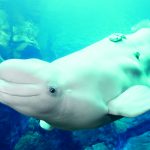
This journal has truly served as a beacon of integrative approaches to animal biology. From my very first papers on running and swimming in diminutive mink (a 1983 two-paper set of all things!) to my lab’s latest article on diving by rotund beluga whales in 2024 (with the JEB cover no less!), you have been there. JEB was the go-to baptism journal for the first publication for most of my graduate students, and the wall of their offices and my lab are proudly graced with photos of their many cover pictures of dolphins, sea otters, Weddell seals, elephants and of course whales.
The launchings of these students and their scientific work, critical for conserving global species, are the real “messages in the bottle” that represent the legacy of George Parker Bidder III and The Company of Biologists. Well done! We will forever be grateful.
Giulia Rossi
Postdoctoral Researcher
My visit to Craig Franklin’s lab at the University of Queensland, supported by a Travelling Fellowship from The Company of Biologists, has been pivotal in shaping my early research career.
Our project challenged me to think more creatively about the mechanisms that animals use to tolerate extreme environmental conditions. Beyond the research itself, my time in Craig’s lab was transformative in other ways. I was immersed in a dynamic and diverse group of researchers, each bringing unique perspectives and expertise. Engaging with the lab reinforced my appreciation for the power of exchanging ideas across institutions and geographic boundaries. The friendships and connections I built during this time have led to ongoing collaborations and continue to influence my approach to research. These experiences not only advance scientific discovery, but also foster the kind, supportive and innovative community that drives meaningful research.
As a postdoc, I wrote several articles for Outside JEB, an experience that honed my skills in distilling complex scientific findings into accessible narratives for a broad audience. I also frequently turn to Journal of Experimental Biology to publish my work, valuing its broad readership and impact in the field of experimental animal biology.
Martin Alejandro Mecchia
Postdoc

Whilst working as a postdoc in Argentina, I started a collaboration with Dr Grossniklaus (UZH, Switzerland). To visit Dr Grossniklaus’s lab, I applied for a Travelling Fellowship from The Company of Biologists.
The Travelling Fellowship was really important for the collaboration, which culminated in a paper published in Science (Mecchia et al. 2017). Later on, I joined Dr Grossniklaus’s lab in Zurich as a postdoc. We have since published a paper in Development (Mecchia et al. 2022).
The Travelling Fellowship was important not only for my career but also for my personal life. I can say that I am still happily living in Zurich.
Deeksha Prasad
Senior Research Fellow
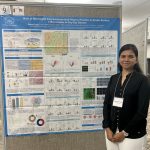
The Company of Biologists provided financial support through a Disease Models & Mechanisms Conference Travel Grant, making it possible for me to attend a Gordon Research Conference.
Attending the conference allowed me to connect with leading experts in ocular surface biology, engage in insightful discussions and gain valuable feedback on my work. Conversations with researchers working on inflammation, biomaterials and regenerative medicine have given me fresh perspectives and new ideas that will help shape the next phase of my research.
This experience has not only deepened my understanding but also opened doors for potential collaborations that could significantly impact my future career.
Danielle Levesque
Associate Professor
The Company of Biologists and Journal of Experimental Biology, in particular, have been a large part of my career. My first ever paper was published in JEB, and I’ve enjoyed every publishing experience with them since. I learned a lot while contributing to Outside JEB during my postdoc and use it as an activity in my graduate classes. I really enjoyed catching up with Kathryn Knight, JEB News & Views Editor, later in my career when she interviewed me for one of the early-career spotlights.
A Travelling Fellowship from JEB helped start a project that later became a postdoc position with Dr Andrew Alek Tuen in Malaysia. That’s now led to a decade of fascinating research on tropical endothermy!
JEB has been a constant, encouraging presence throughout my career, and I look forward to what comes next!
Joachim Goedhart
Associate Professor
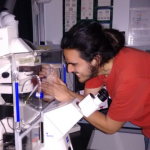
When I learned that The Company of Biologists, and especially Journal of Cell Science, had joined the Review Commons initiative, I was very excited. Since then, we have published three papers in JCS through Review Commons, and the whole process felt liberating. We were much more in control of follow-up experiments. This is an enormous help to the PhD candidates who were first authors, as it is clear what was expected. Therefore, the whole process is more predictable, doable and less stressful.
Thank you on behalf of our team and especially the PhD candidates that were involved. Keep up the good work and I hope that The Company of Biologists remains open to new, modern ways that improve the publishing process.
Image: PhD candidate Sergei Chavez Abiega, first author of a paper that was submitted via Review Commons (https://doi.org/10.1242/jcs.259685). Thanks to the smooth review process facilitated by Review Commons there is more time left for experiments.
Muktar Lawan
Research Assistant
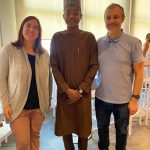
The Company of Biologists has supported me in my career by providing a JCS-FocalPlane Training Grant that enabled me to attend a training program on hyperspectral imaging and phasor analysis at the Institut Pasteur Montevideo in Uruguay. This training has equipped me with cutting-edge skills that I can apply to my PhD research and future projects.
The training grant from The Company of Biologists brought me to Uruguay, where I met and learned from Leonel Malacrida, a renowned expert in hyperspectral imaging. This connection has been instrumental in shaping my research skills and career, as I can now apply the knowledge and techniques I acquired to my PhD research and share them with others in Africa, where this technology is not well-known.
I am grateful for the support of The Company of Biologists, which has enabled me to acquire skills that will benefit not only my research but also the broader scientific community in Africa. I appreciate the opportunity to learn from experts like Leonel Malacrida and look forward to applying and sharing my knowledge in the future.
Andy Reynolds
Principal Investigator
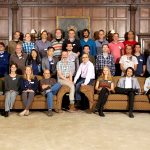
A Workshop, very generously funded and organised to perfection by The Company of Biologists, was the culmination of a decade of intense research and fierce debate. It was a high point of my career.
The resulting publication in The Company of Biologists’ journal ‘Biology Open’ has been highly influential, shaping much subsequent debate, and eight years on continues to gather citations monthly.
I remain deeply indebted to The Company of Biologists.
Ambuj Mishra
PhD Scholar
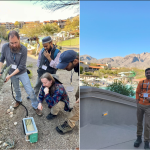
The Company of Biologists, through the Society for Experimental Biology Travel Grant, played a pivotal role in advancing both the quality and impact of my scientific career. The grant enabled me to attend the LI-COR Connect 2025 workshop in the USA held in February 2025, where I received intensive training in advanced plant gas exchange measurements and modeling using the LI-6800 system. This hands-on training significantly refined my research methods and directly led to the improvement of a major manuscript I am now preparing for submission. This opportunity not only elevated my technical capacity but also expanded my confidence as a researcher working at the interface of plant physiological ecology and climate adaptation.
The support from The Company of Biologists made it possible for me to travel internationally and build meaningful connections that will shape my career for years to come. During the LI-COR Connect event, I established collaborative links with scientific staff from LI-COR, including Dr Richards Vath and Dr Seton Bachle, with whom I am now planning a methodological publication.
Furthermore, visits to the labs of Prof Brian Enquist (University of Arizona) and Prof Louis Santiago (University of California, Riverside) enabled me to present my research, receive invaluable feedback, and initiate discussions on future joint research. These connections have directly influenced my ongoing research design and long-term collaborative goals in Plant Ecophysiology.
I am deeply grateful for this support and proud to be part of a community that empowers early-career scientists through such impactful opportunities.
Rafael Galupa
Group Leader
I’m proud to say that my career and The Company of Biologists have been intertwined for many years. I published one of my PhD papers in Development, a process that was very smooth and constructive, after revisions via Review Commons. During my postdoc times, I participated in the preLights initiative, which gave me the chance to interact with other early-career researchers.
The Company of Biologists has also supported the X-chromosome inactivation conference in 2023 that I co-organised, after which I was invited to write a review on dosage compensation for Development. I was about to start my own research group and Alex Eve (Development’s Reviews Editor at the time) kindly agreed to extend the submission date for this review, so I could involve the first PhD student on the team in its writing! The Company of Biologists is really an essential member of the life sciences community.
In terms of connections, writing for preLights put me in touch with other preLighters and with the authors of the preprints I chose to highlight. The invitation to write a review was a great opportunity to reach out to Beatriz Viçoso, an evolutionary biologist; I knew Beatriz’s work, but we had never interacted, and it was great to write the review together and intersect my molecular genetics perspective with her knowledge and insight on the evolution of the sex chromosomes.
Rebekah Tillotson
Group Leader
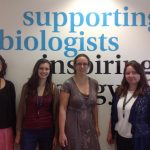
My internship at The Company of Biologists in 2015 (during my PhD) gave me an experience of the “good” side of publishing, where science and community are put before profit. This training helped me understand how journals can transition to being open access and what the APC covers. I am excited by more recent initiatives at The Company of Biologists, such as Read & Publish Agreements and preLights.
I have remained in academic research, establishing an independent group last year. My time spent at The Company of Biologists gave me a more positive view of publishing.
Taisa Bohdanovych
Junior Research Scientist
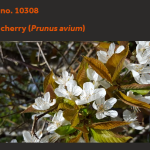
Thanks to The Company of Biologists for the publication of our article. It is a great pleasure to know that you have such wonderful projects as The Forest of Biologists. Thank you for the tree planting – I genuinely hope to travel to Mead one day and find that tree.
It is my first publication in such a high-ranking journal as the first author, so I will always remember this experience and am very grateful. It is touching to know that there is a wild cherry tree growing in the UK that is now somehow linked to me.
Zehuan Liao
Research Fellow

In early 2025, I was honored to receive a Travelling Fellowship from Disease Models & Mechanisms (DMM), a journal of The Company of Biologists. This fellowship supported my collaborative research visit to Dr Ziyuan Guo’s laboratory at the Center for Stem Cell & Organoid Medicine (CuSTOM) at Cincinnati Children’s Hospital Medical Center. The Guo Lab is widely recognized for its expertise in studying the complexity of human brain development using induced pluripotent stem cell (iPSC)-differentiated cell and organoid models. During my visit, I learned to generate brain organoids from iPSCs derived from patients with spinocerebellar ataxia type 12 (SCA12). These SCA12 organoids provide a powerful platform to investigate disease mechanisms in a more physiologically relevant human context.
Visiting and collaborating with Dr Guo and his team expanded my expertise in studying spinocerebellar ataxia type 12 (SCA12) using not only mouse models, but also human induced pluripotent stem cell (iPSC)–derived organoid models. This is especially timely as the field is increasingly emphasizing the use of more human-relevant systems, including organoids, to strengthen the translational value of my research. Incorporating organoid models can help me validate key findings in a human context and better position future work for clinical translation. I am also deeply grateful to my supervisor, Dr Pan Li, for supporting these research visits and encouraging this collaborative direction.
Denis Duboule
Professor
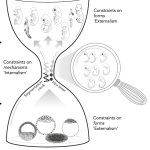
Two of my most important papers were published in the former yearly ‘Supplement’ to Development (just before I became an Editor), which presented papers delivered at the British Society for Developmental Biology. Gaunt, Sharpe and Duboule (1988) on the discovery of collinearity in vertebrates and Duboule (1994) on the Hox clock and the Developmental Hourglass (this was a plenary lecture at the BSDB that year). These were critical to my career, and the papers are still cited today.
These papers helped me really enter the British community of developmental biologists, with more than 30 years of friendship with many colleagues, a few of whom are still active.
Salah Elias
Associate Professor
Over the years, The Company of Biologists has supported several of our initiatives:
- For the NewPICellDev Forum, which I launched in May 2020, the Node has been instrumental in allowing us to reach out to and connect with the community worldwide through social media, an interview and its networking event in July 2020.
- The Company of Biologists and Journal of Cell Science sponsored our NewPICellDev meeting “Emerging Concepts in Cell and Developmental Biology,” which took place in Aarhus, Denmark, in September 2022.
- Development also supported our seminar series (2023-2024) within the Southern Stem Cell & Regeneration Network (SSCRNet).
Maximiliano Gutierrez
Principal Group Leader
When doing my PhD, in 2003, I received a JCS Travelling Fellowship to travel to EMBL in Heidelberg (Germany). Thanks to this fellowship, I learned electron microscopy in the lab of Gareth Griffiths. Since then, my passion for electron microscopy has profoundly influenced the research in my lab. I am currently at the Francis Crick Institute in London.
This experience has definitely connected me to someone who has helped share my career. I met my mentor and friend Gareth Griffiths when I came back as a postdoc in 2006. The exposure to EMBL and all the people I met there were instrumental for my career.
Thank you!
Our 100 years were only possible because of the people involved, like you. Thanks to everyone who shared their story with us, and everyone who has been part of our story over the past decades.